
FIFA Pace Calculator

Related Calculators
FIFA Pace Calculator guide
Table of Contents
Tap a section to jump instantly
Pro tip: If you’re tracking hydration, keep your daily water goal consistent even on rest days.
What FIFA Pace Really Means
In football (soccer), “pace” usually describes how fast a player can cover ground in short bursts—especially in sprints, quick transitions, and runs behind defenders. In FIFA-style ratings, pace often feels like a single number that tells you how dangerous a player is in open space.
But in real life, pace is not just “top speed”. It includes how quickly you accelerate, how long you can maintain speed, and how well you repeat sprints with short recovery.
FIFA Pace Calculator: What This Page Measures
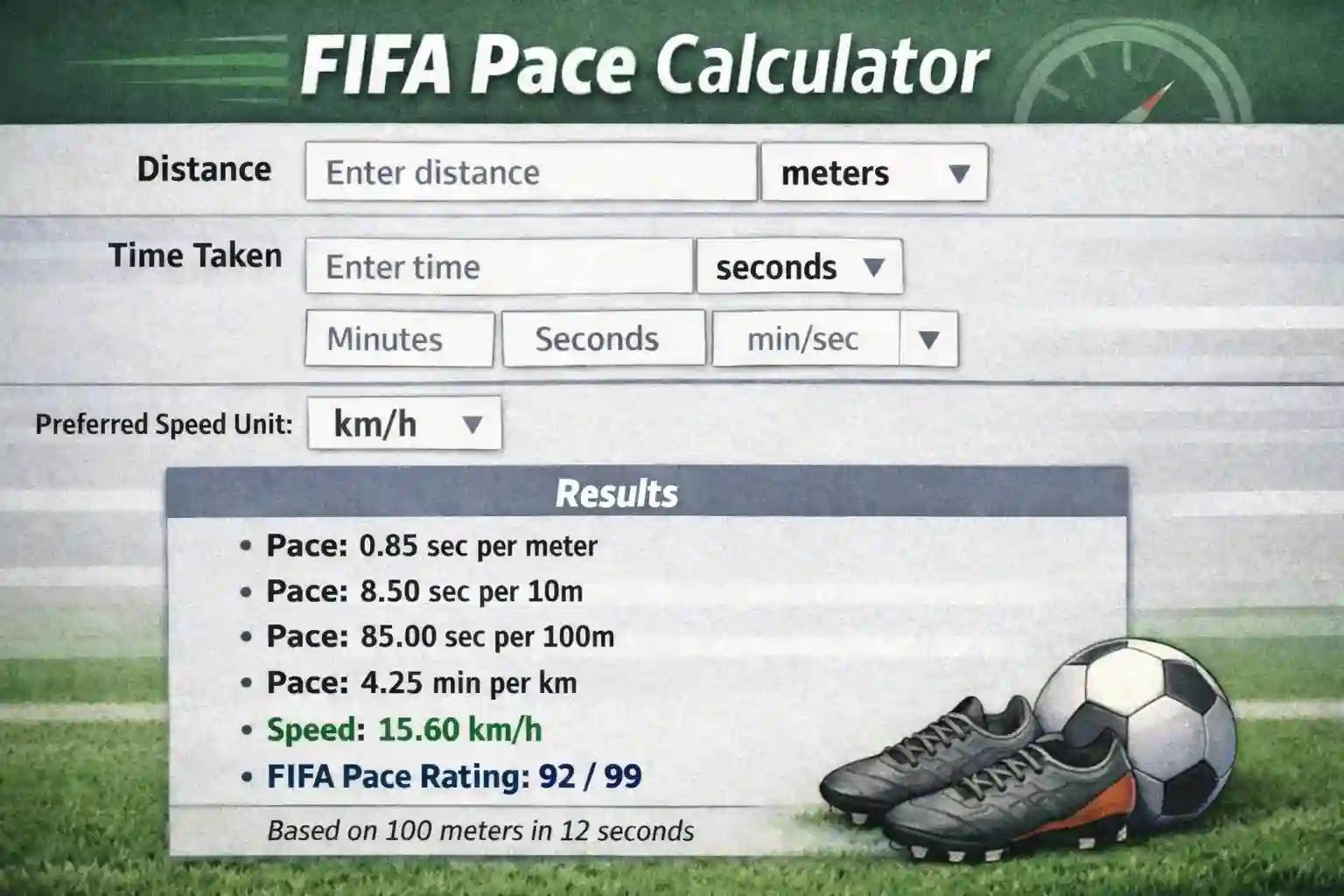
The fifa pace calculator on this page takes your distance and time and breaks the result into practical formats that runners and football players actually use.
You’ll see pace for different distances (per meter, 10m, 100m, and per km) and also a speed output in your preferred unit. Finally, it maps your real sprint performance to a FIFA-style pace score (1–99) so it’s easier to compare over time.
Pace Calculator FIFA: When to Use It
A pace calculator fifa result is most useful when you want a consistent way to track speed changes without guessing.
- Comparing your sprint time improvements across weeks
- Checking whether your acceleration work is actually helping
- Converting training runs into a “pace number” you can remember
- Comparing two athletes using the same distance and time method
Inputs Explained (Distance, Time, Units)
Your output depends entirely on how clean your inputs are. Small unit mistakes can massively change the final pace and rating.
Distance
Choose meters or yards depending on how your run was measured. Yards are common for tests like 40 yards, while meters are common for 30m, 60m, and 100m.
Time Taken
You can enter your time in seconds, minutes, or split format (min/sec). For sprint work, seconds is usually the best option because it avoids confusion.
Preferred Speed Unit
Speed can be displayed in km/h, m/s, or mph. The math stays the same— only the display changes.
How the Calculation Works (Conceptual)
The core idea is simple: divide distance by time to get speed, and then flip it to get pace.
Speed (m/s) = Distance (m) / Time (s) Pace (sec per meter) = Time (s) / Distance (m) Pace (sec per 10m) = Pace (sec/m) × 10 Pace (sec per 100m) = Pace (sec/m) × 100 Pace (min per km) = (Pace (sec/m) × 1000) / 60
If you use yards, the calculator converts your distance first:
Distance (meters) = Distance (yards) × 0.9144
For FIFA-style scoring, your real speed is mapped to a 1–99 scale so you can compare results easily. This answers searches like calculate fifa pace in a practical performance way.
How to Read Your Results
Each output tells a slightly different story, so it helps to interpret them correctly instead of looking at only one number.
Pace per meter (sec/m)
This is your most “raw” pace metric. It’s great for comparing tests with different distances because it scales cleanly.
Pace per 10m
This is useful for acceleration-style thinking. Football sprint bursts often happen in small chunks rather than full 100m runs.
Pace per 100m
This number feels close to sprint timing. If you want a quick sprint interpretation, this is often the easiest output to understand at a glance.
Pace per km (min/km)
This is a runner-style pacing format. It’s helpful if your test was longer than a sprint or if you want a cardio benchmark.
Speed (km/h, m/s, mph)
Speed is the best metric to compare against other sports contexts. If you track speed, you can also compare it with GPS-based numbers.
FIFA Pace Rating (1–99)
This is the motivational “game-style” score. It’s easiest for weekly comparison, progress tracking, and quick brag-free benchmarking.
Realistic Examples (With Interpretation)
Example 1: 100 meters in 13.2 seconds
This is a common sprint-style test. If you’re specifically trying to check fifa calculator pace 100m performance, 100m is a strong reference distance.
You’ll see pace per 100m close to your sprint time, plus a speed number that’s easy to compare week to week. Your FIFA-style rating will land in a moderate range depending on the speed mapping.
Example 2: 40 yards in 5.2 seconds
Yard tests are popular in speed training. Once the calculator converts yards to meters, it produces the same pace and speed logic without any manual steps.
Example 3: 1 km in 5 minutes 30 seconds
This one is more endurance-driven. Your pace per km becomes the most meaningful output here, while FIFA-style pace can still be used as a fun single-number tracker.
Common Mistakes That Change the Result
- Entering time in minutes when you meant seconds (biggest error)
- Using a distance that was estimated instead of measured (adds noise)
- Timing with a late start/stop (phone stopwatch delay is common)
- Comparing results from different surfaces (grass vs turf vs track)
- Ignoring fatigue (a second sprint is usually slower without rest)
Accuracy, Edge Cases, and Limitations
This calculator is excellent for tracking your own progress, but it cannot perfectly replicate how FIFA assigns pace ratings to professional players.
If you’re researching how does fifa calculate pace, it’s important to understand that in-game ratings come from scouting, performance context, and internal balancing—not only sprint math.
Your result can also be affected by:
- Wind and temperature
- Footwear and traction
- Reaction time vs actual running time
- Short-distance timing errors (even 0.2s matters a lot)
Practical Training Tips Based on Your Pace
If your speed is decent but your FIFA-style pace score is not improving, the issue is often acceleration, not “top speed”.
- Improve first-step quickness: short sprints (5–15m) with full rest
- Improve acceleration: 10–30m sprints, hill sprints, or resisted runs
- Improve repeat pace: sprint intervals with controlled recovery
- Track progress weekly with the same distance and surface
If you want a science-backed overview of sprint training and athletic performance concepts, a good starting point is NCBI’s sports science articles.
Trusted References (Optional Reading)
For official unit conversion definitions and measurement standards, you can reference International System of Units overview.