
Mortgage Calculator Games
Related Calculators
Mortgage Calculator Games Guide
Table of Contents
Tap a section to jump instantly
Pro tip: If you’re tracking hydration, keep your daily water goal consistent even on rest days.
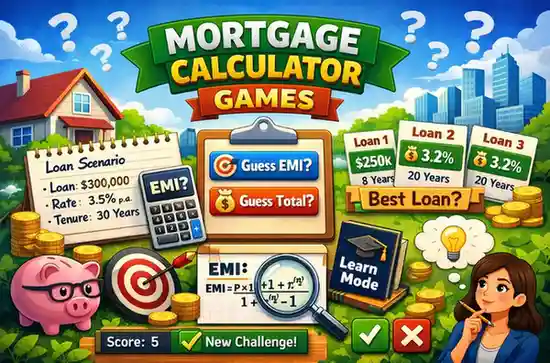
Buying a home involves more than just knowing the loan amount. You must understand monthly EMI, total repayment, and how interest compounds over time. This interactive mortgage game turns serious financial math into practical decision-making practice.
Instead of passively reading numbers, you actively guess, compare, and evaluate different loan scenarios. That builds intuition about real borrowing costs.
How this calculator works
The game is built on the standard amortized loan formula used by banks. Each scenario randomly selects:
- Loan amount
- Annual interest rate
- Loan tenure
Depending on the mode, you either:
- Guess the monthly EMI
- Guess total repayment
- Select the most economical loan option
- Enter custom values in Learn Mode
The calculation logic follows guidelines consistent with amortization methods described by the Consumer Financial Protection Bureau.
Mortgage formula explained
EMI is calculated using:
EMI = P × r × (1 + r)^n / ((1 + r)^n − 1) Where: P = Loan amount r = Monthly interest rate (Annual Rate / 12 / 100) n = Total number of monthly payments
Total repayment is:
Total Payment = EMI × Total Months
Example
| Loan Amount | Rate | Tenure |
|---|---|---|
| $300,000 | 4% | 30 Years |
Monthly rate = 4 / 12 / 100 = 0.00333 Total months = 360 EMI ≈ $1,432 Total repayment ≈ $515,520
Notice how interest adds over $215,000 beyond the original principal.
Real-life use cases
- Comparing 20-year vs 30-year mortgage options
- Understanding how small rate changes impact total interest
- Preparing before speaking to a lender
- Training finance students in amortization concepts
Mortgage structures follow amortization practices described in Britannica’s mortgage overview, making this tool educational as well as practical.
Interpreting your results correctly
A lower EMI does not always mean a better loan.
- Long tenure → Lower EMI but higher total interest
- Short tenure → Higher EMI but lower total repayment
- Small rate differences compound significantly over time
In Best Loan mode, the game evaluates total repayment, not just interest rate.
Common mistakes players make
- Assuming lowest interest rate always wins
- Ignoring tenure differences
- Confusing annual rate with monthly rate
- Forgetting that interest compounds monthly
Many borrowers underestimate compounding effects, as explained in financial education resources from the Federal Reserve consumer resources.
Assumptions and limitations
- Fixed interest rate assumed throughout tenure
- No prepayments included
- No taxes or insurance included
- No processing fees included
Real mortgages may include escrow, property tax, adjustable rates, and refinancing options.
Last updated on: February 3, 2026