
Creatine Water Intake Calculator
Enter your body weight. Default is in kg.
Recommended Water Intake
Based on your weight of 70 kg (70 kg), your daily water intake while supplementing with creatine should be around:
2950 ml (2.95 liters)
- Extra 500ml is added as a creatine buffer
- Stay consistent with intake to avoid dehydration
- Monitor urine color for hydration level
Water (ml) = Weight (kg) × 35 + 500Note: This calculator is for informational purposes only. Always consult your healthcare provider for personalized advice.

Related Calculators
Recommended Water Intake for Creatine Users
Table of Contents
Tap a section to jump instantly
Pro tip: If you’re tracking hydration, keep your daily water goal consistent even on rest days.
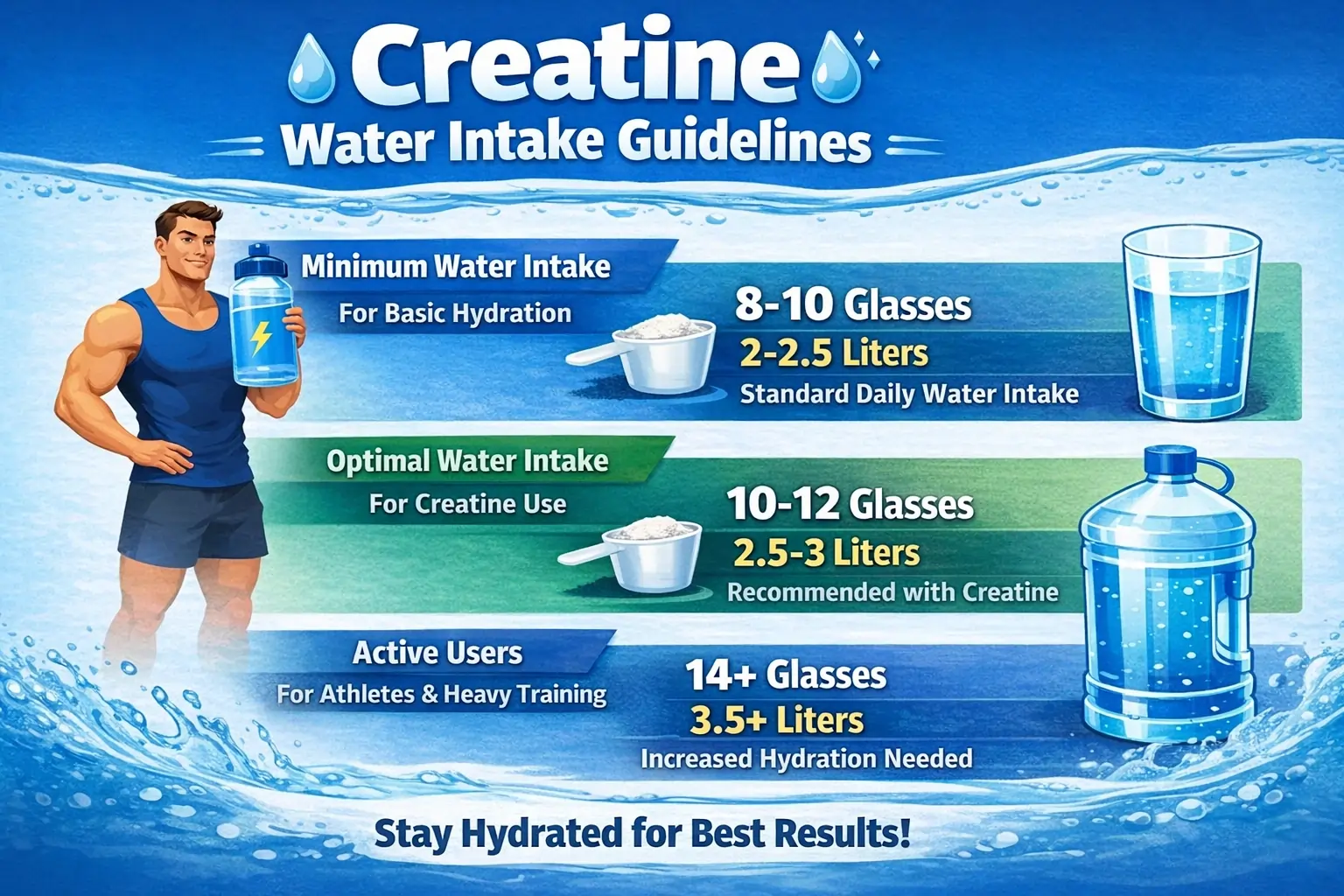
Creatine is one of the most researched supplements in sports nutrition, but hydration is the part most people underestimate. When someone starts taking creatine, they often train harder, sweat more, and expect results quickly — yet water intake stays the same as before. That mismatch is where problems like fatigue, headaches, and “heavy” workouts can start. NIH: Creatine and athletic performance
This page is written for people who want a realistic answer to one question: how much water should I drink on creatine — not in theory, but in daily life.
What this calculator measures
This creatine water intake calculator estimates a daily water target based on your body weight, then adds a hydration buffer that matches how creatine is commonly used in real training routines. Your result is shown in milliliters and liters so you can actually follow it.
Why hydration matters more when you’re taking creatine
Creatine supports strength and performance partly by increasing phosphocreatine availability in muscle. At the same time, it’s common to notice muscles feel fuller, workouts feel more intense, and recovery demands increase. That’s normal — but it also means your hydration habits need to match your new output. ISSN position stand on creatine safety
People often call this a water intake calculator creatine version because a generic water goal doesn’t reflect the real-world situation: more training + creatine + inconsistent hydration.
Inputs explained (and why they matter)
Your body weight
Weight is the strongest starting point for hydration planning because fluid needs scale with body size. This calculator accepts kilograms, pounds, or grams, then converts everything into kilograms before the final water target is produced.
Unit selection (kg, lb, g)
If you switch units, your goal stays consistent because the calculation always works from the same base: your weight in kilograms. That’s why both a water intake calculator for creatine and a water intake calculator with creatine should always include unit conversion.
How the calculation works (the practical logic)
The approach here is intentionally simple: it gives you a baseline that is easy to remember and easy to follow. In my experience working with gym-goers, the best hydration plan is the one you can stick to every single day, not the one that looks perfect on paper.
Water (ml/day) = Weight (kg) × 35 + 500
The “35 ml per kg” portion is a practical hydration estimate used widely in fitness settings. The extra 500 ml is added as a buffer because creatine users often push training intensity, sweat more, and need a slightly more conservative hydration baseline to feel consistently good.
How to interpret your result
Your output is a daily target, not a “drink this right now” number. If the calculator shows 2.95 liters, the goal is to spread it across the day so your hydration stays stable — especially around training. Mayo Clinic water intake guidance
- If your workouts feel flat, recovery is slow, or you get headaches easily, treat the result as your minimum daily baseline.
- If you sweat heavily or train in hot weather, you may need more than the result even if your weight is the same.
- If you’re constantly peeing clear urine every 20 minutes, you may be forcing water too aggressively.
Realistic examples (what people actually do)
Example 1: 70 kg person starting creatine
A 70 kg lifter takes creatine daily and trains 4–5 days per week. The calculator gives: 70 × 35 + 500 = 2950 ml/day (2.95 L). This is usually enough for good workouts if they spread it evenly: morning water, steady sipping, and extra around gym time.
Example 2: 80 kg person training in a hot climate
An 80 kg person training in heat often sweats more than expected. The baseline becomes: 80 × 35 + 500 = 3300 ml/day (3.3 L). In summer workouts, they may still need extra fluids or electrolytes, but this number is a solid anchor to prevent under-drinking.
Common mistakes people make on creatine + hydration
- Treating hydration like a workout-only habit instead of an all-day routine.
- Drinking a huge amount at night and assuming it replaces consistent daytime intake.
- Assuming creatine “doesn’t suit me” when the real issue is low water intake and low electrolytes.
- Copying a friend’s water goal without adjusting for body weight, sweat rate, and workout duration.
Assumptions and edge cases
This water intake creatine calculator assumes you are a generally healthy adult with normal kidney function and no medical fluid restrictions. It also assumes you are not losing unusually high fluids through long endurance sessions, extreme heat exposure, or illness.
If you are in a heavy sweat situation, this water intake on creatine calculator number should be treated as a baseline — not the ceiling.
When results may not be accurate
No hydration calculation can perfectly predict your needs because water balance depends on more than weight. Salt intake, diet quality, sleep, stress, caffeine, alcohol, and training intensity all change how you feel on the same amount of water.
If you have kidney disease, heart disease, uncontrolled blood pressure, or your doctor has told you to limit fluids, you should not follow a fixed water target without medical advice.
Practical tips from real usage (simple, high impact)
- Split your daily total into “easy checkpoints” (morning, midday, pre-workout, post-workout).
- If you train hard, consider electrolytes instead of only increasing plain water.
- Keep your creatine dose consistent. Your water routine should be consistent too.
- Monitor hydration by energy, performance, and urine color (light yellow is usually a good sign).
ACSM guidance on exercise hydration
Limitations (honest and important)
This water intake calculator on creatine is designed for practicality, not medical diagnosis. It does not measure dehydration clinically, does not account for lab results, and does not replace professional medical advice.
If your training volume is very high, your sweating is extreme, or you’re doing long outdoor sessions, you may need to go beyond the baseline and use thirst + performance feedback to adjust.
Faqs
Conclusion
Creatine doesn’t “work like magic” — it works best when the basics are stable: training, sleep, nutrition, and hydration. A consistent daily water target is one of the easiest upgrades you can make, and it often improves energy and workout quality within days.